
















- A March 2026 Anthropic study shows AI has near-zero impact on frontline roles (food service, retail, field work)
- Frontline workers aren’t being displaced by AI — they’re being underserved
- In hospitality, retail, and FMCG, this is a revenue issue, not a technology issue
- Companies that equip frontline teams with AI-native tools will execute faster, retain longer, and drive higher conversion than those relying on LMS and static training
The Chart That Changes the Conversation
The dominant narrative around AI is job displacement.
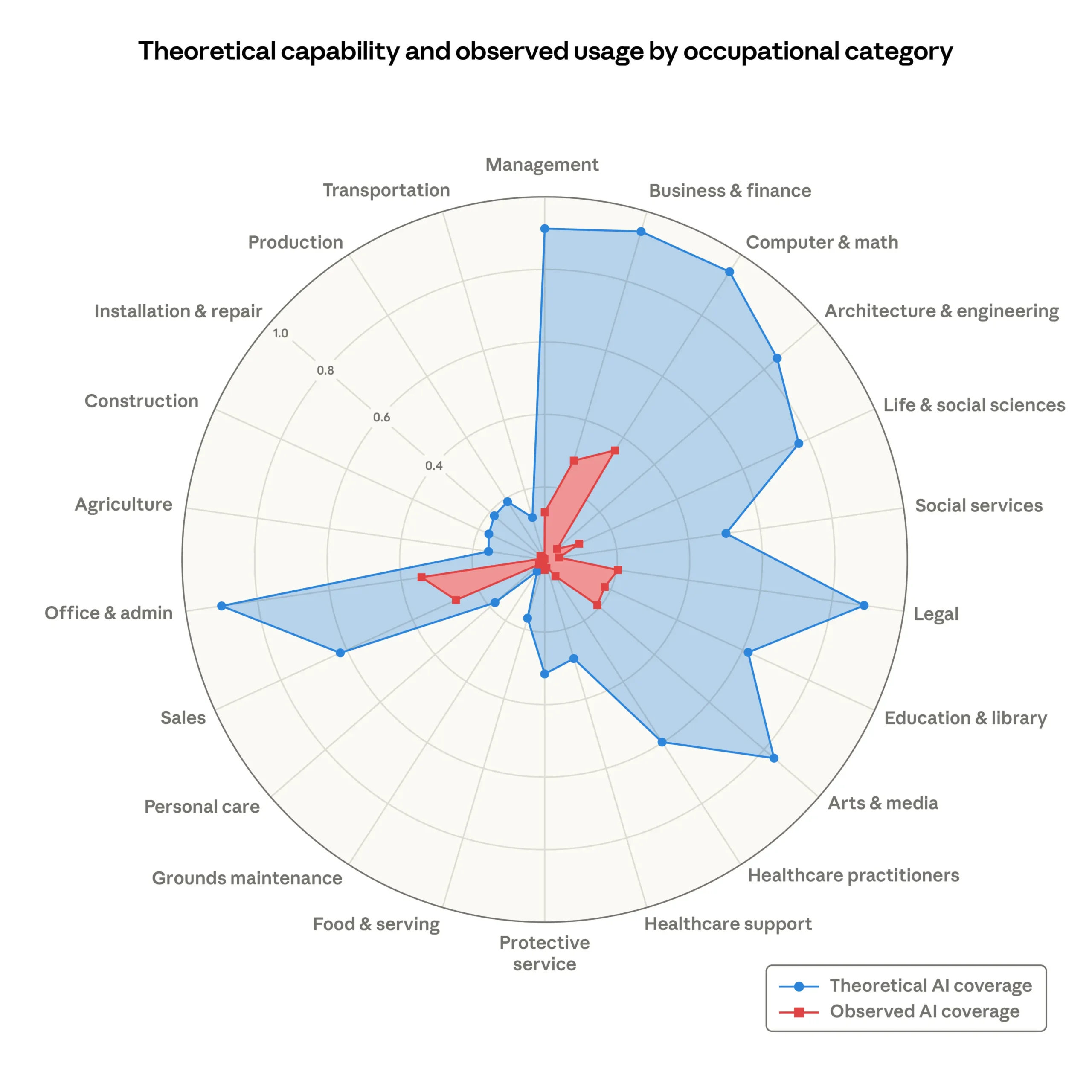
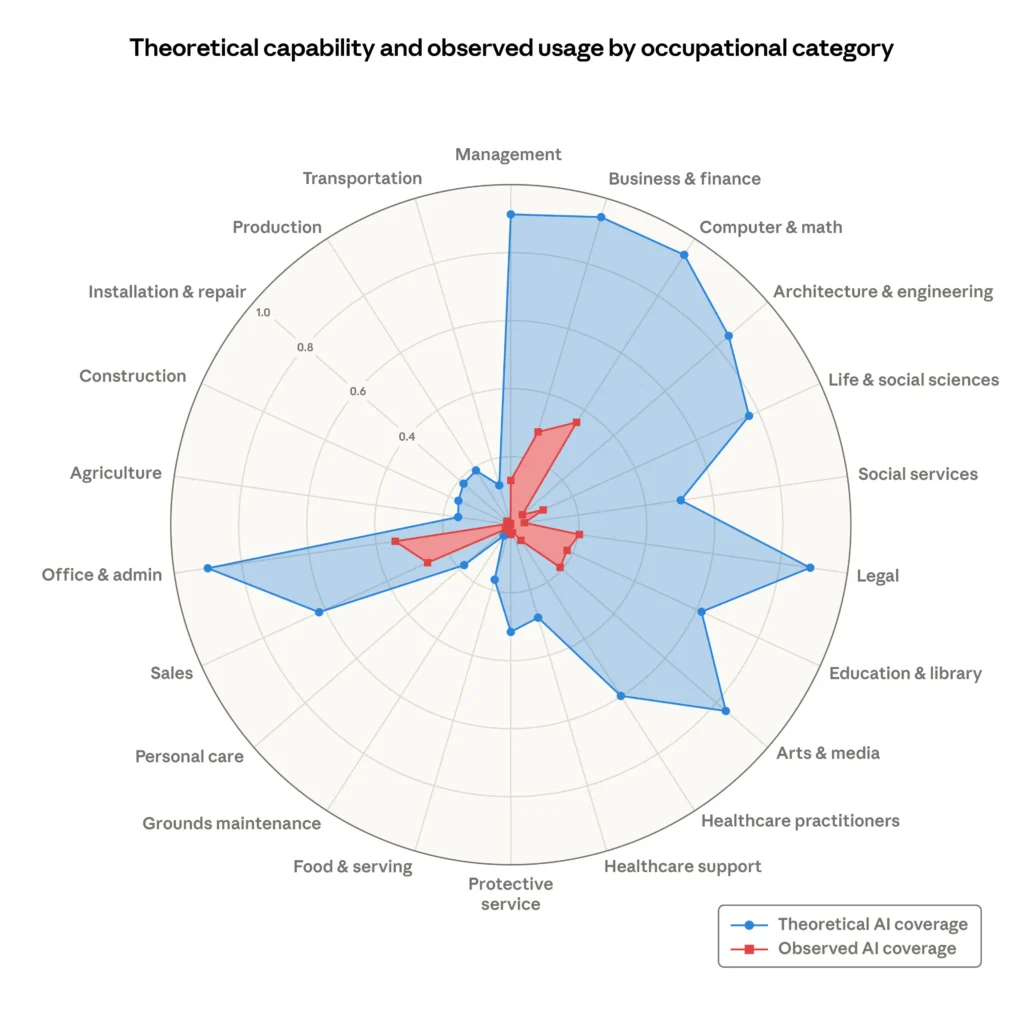
For frontline workers, that narrative is wrong.A new study from Anthropic — Labor Market Impacts of AI: A New Measure and Early Evidence (March 2026) — introduces a more grounded way to measure AI’s real-world impact. It compares theoretical AI capability (what AI could do) with observed usage (what it is actually used for across occupations).
The results are clear.
In management, business, finance, and technical roles, AI shows both meaningful theoretical coverage and growing real-world usage.
In frontline roles — food service, personal care, construction, retail, and field work — both numbers are near zero.
These jobs require physical presence, real-time judgment, and human interaction. But more importantly, they don’t happen in environments where current AI tools can be used.
Frontline workers aren’t being displaced. They’re being underserved.
Frontline Workers Aren’t Being Displaced. They’re Being Underserved.
The conversation around AI and employment has focused heavily on risk: which roles will be automated, which workers will need to retrain, which industries will be disrupted.
For frontline workers — the 2.8 billion people globally working in hospitality, retail, FMCG, logistics, and field operations — that framing misses the point.
According to the Anthropic research, roughly 30% of U.S. workers show zero observed AI usage. This group includes cooks, retail associates, mechanics, and service workers.
These aren’t jobs at risk of automation. They are jobs current AI systems can’t meaningfully perform — and, as a result, haven’t been meaningfully supported.
The question isn’t whether AI will replace these workers.
It’s whether companies are giving them the tools to perform at their best.
Why Frontline Workers Are Still Underequipped
This isn’t a budget issue. Companies already invest heavily in HR tech, training platforms, and enterprise software.
The problem is that most of these systems were built for desk-based work.
They assume:
- a login
- a laptop
- uninterrupted time
Frontline work is the opposite: high-frequency, high-interruption, phone-in-pocket, customer-in-front-of-you.
As a result, tools that work well for office teams rarely translate.
This Gap Is a P&L Problem
The implications show up directly in execution.
A hotel associate who doesn’t confidently offer a room upgrade leaves revenue on the table at every check-in.
A retail employee who can’t answer a product question in real time loses the sale.
An FMCG field rep who spends too long on in-store tasks covers fewer locations, creating space for competitors.
Even small improvements in execution, applied across hundreds of locations and thousands of employees, translate into meaningful revenue gains.
This isn’t a training problem. It’s a performance problem.
See how Leonardo Hotels delivers training to frontline teams’ phones — in the flow of work →
What Effective Frontline AI Enablement Looks Like
The systems that are starting to work share a few characteristics.
They are built around how frontline work actually happens, not how office work is structured:
- Zero-login delivery — no portals or credentials required
- Distribution through existing channels — WhatsApp, SMS, Teams, Slack
- Micro-format content — short, actionable guidance instead of long modules
- Real-time access — information available at the moment of need
In high-turnover environments, these systems also capture and distribute institutional knowledge that would otherwise be lost.
The Opportunity Is Still Wide Open
The AI market for knowledge workers is already crowded. Vendors are competing on similar capabilities, and differentiation is narrowing.
The frontline market is fundamentally different.
The workforce is large, the ROI is immediate, and existing tools don’t fit the environment.
The companies that move early — equipping frontline teams with tools that match how they actually work — will build a meaningful execution advantage.
If your frontline teams are still relying on LMS modules and PDFs, you’re leaving execution — and revenue — on the table.
See how Bites equips frontline teams in real time →
Frequently Asked Questions
No. Frontline roles require physical presence, real-time judgment, and interpersonal skills that current AI systems cannot replicate.
Most AI tools are designed for desk-based environments and require access patterns that don’t match frontline work.
Roughly 2.8 billion people globally are considered deskless or frontline workers across industries like hospitality, retail, and logistics.
Tools that deliver short, actionable content to frontline workers through existing communication channels (without requiring logins) tend to see higher adoption.
AI will assist frontline workers in retail and hospitality, but full automation is unlikely. These roles rely on human interaction, judgment, and real-time decision-making.